Platform Wars
Table of Contents
One of the basic concepts of capitalism is the idea that competition is good for consumers. I think in most cases this is true. One famous example is the history of General Motors, a company that became so powerful and dominant that the US government considered breaking GM into separate companies.

GM was never broken up, and in the end their dominance waned. Now GM ranks 4th globally in terms of number of vehicles sold, so they hardly went away, but they don’t control anywhere close to the majority of the market.
How did this happen? There are differing theories: failure to innovate, poor execution, bad strategy. Another, more likely explanation is that Asian manufacturers (Toyota, Hyundai, Honda, Nissan) started producing higher quality, less expensive automobiles than GM, and GM failed to adapt. These competitors chipped away at GM’s dominance.
In any case, consumers ended up with cheaper cars and better alternatives to GM.
Platforms #
Today our digital lives are largely dominated by 2 companies, Apple and Google. They are the only relevant mobile platform vendors, and they both operate walled gardens for their devices. As consumers we have little choice outside of this duopoly.
In order to publish on Apple or Google’s platform (via their respective app stores), you must first get permission to operate from those companies.
In other words, if I buy an iPhone, it is Apple who decides what software I can run on my phone. As a publisher, I can’t publish software unless it earns the Apple or Google seal of approval.
What you’re buying is hardware that Apple still gets to heavily control.
To use an analogy, imagine if you bought a Prius and you were only allowed to drive to Toyota approved destinations on Toyota approved roads.
At War #
Apple recently announced it would warn users about apps that were tracking them, and provided them a prompt to ask the app not to track them. Some might interpret this as a shot across the bow at ad companies like Google and Facebook whose main business proposition is the idea that they have high quality targeting data based on behavioral tracking and surveillance.
Sounds like a win for users, right? Not so fast.
Amusingly, Apple simultaneously offered their own tool for tracking that would not trigger the warning, as per a Reuters article. One could interpret this as a prelude to Apple’s intention to enter the advertising market alongside Google and Facebook. It may also just be Apple using privacy as a way to advantage its own ad business.
This pattern isn’t new. In platform economics, it’s known as “envelopment” – when a platform provider uses its control of one area to expand into adjacent markets1. Microsoft did this in the 1990s with Internet Explorer, bundling it with Windows to defeat Netscape. Same move, different decade.
The End of the Web #
Another trend happening simultaneously is the move from open web platforms to app-based walled gardens. You can see this manifested directly in the attempts of major platforms to disable sharing of files and URLs.
For example, if I share a link on Twitter, it will replace that link with Twitter’s own tracking URL that requires redirection through Twitter’s platform. The same is true for videos (and all files for that matter): you can’t simply attach a file to a tweet and share it. There are ways to download videos from Twitter, but Twitter makes it as hard as possible for you to do that.
The web was originally designed as an open platform where anyone could publish content without gatekeepers. Tim Berners-Lee, the web’s inventor, envisioned it as “an open platform that would allow everyone, everywhere to share information, access opportunities, and collaborate across geographic and cultural boundaries.”2 App stores and locked-down sharing push in the opposite direction.
Who’s Winning? #
Without question the biggest winners are the platforms. They’re optimized for stickiness, and the effect has been unquestionably powerful. It’s like going to the grocery store and being allowed to buy as much ice cream as you want, but there are only two flavours available: chocolate or vanilla. All other flavours are bad.
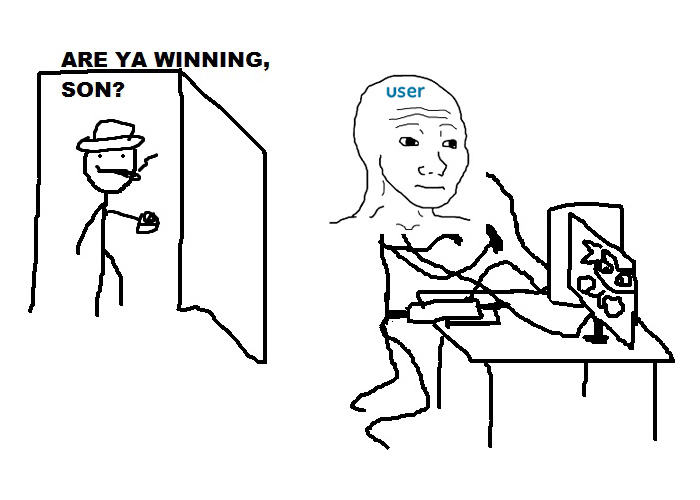
Unlike the automobile industry, the software world exhibits strong network effects, especially since nearly every platform is some kind of social network.
Users lose out (or as I like to say, users get used), small publishers lose out, and the amount of diversity of thought and ideas becomes narrower and more homogenized as platform gatekeepers determine what content is acceptable.
In the Digital Age, Does Ownership Exist? #
As I mentioned before, when you buy an iPhone you don’t really own the hardware, since you don’t get to decide what software you run.
Another example of this effect are DRM-encumbered digital books: you can’t lend them out, and you can’t sell them to anyone.
There’s a case in front of the courts right now which the EFF has promised to help with in an attempt to protect our right to lend books, digital or otherwise. It’ll be interesting to watch and see where things go.
When you “buy” digital content, you’re often just purchasing a limited license to access that content under specific conditions that can change at any time. As law professor Aaron Perzanowski puts it, “What consumers own is not a collection of digital books, but a bundle of legal risks.”3
That fight may end up mattering more than the one between the tech giants themselves.
Eisenmann, T., Parker, G., & Van Alstyne, M. (2011). “Platform envelopment.” Strategic Management Journal, 32(12), 1270-1285. ↩︎
World Wide Web Foundation. “History of the Web.” https://webfoundation.org/about/vision/history-of-the-web/ ↩︎
Perzanowski, A., & Schultz, J. (2016). “The End of Ownership: Personal Property in the Digital Economy.” MIT Press. ↩︎